exhibition.
Curated by Sophie Bonet
The Frank C. Ortis Gallery
Pembroke Pines, FL
Mar 13-June 7, 2025
Adventum Floridana: Witnessing the Layers of a Vanishing Horizon
Landscapes are never neutral. They are storied, layered, and alive—bearing witness to the collisions of memory, environment, and human desire. In Adventum Floridana, artist Andrés Cabrera-García offers us more than depictions of place; he constructs a sensorial archive. His canvases are not passive representations, but embodied cartographies that ask us to feel through sight—to move beyond observation and toward immersion.
Drawing upon Maurice Merleau-Ponty’s phenomenology of perception, Cabrera’s work underscores that we do not merely see the world—we inhabit it. “The body is our general medium for having a world,” Merleau-Ponty writes. “We grasp the unity of the object with our whole body.”¹ In this way, Adventum Floridana becomes a proposition: that painting can hold the tension of ecological trauma, cultural displacement, and the quiet persistence of memory.
Cabrera’s process is one of excavation. Through oils, pigments, and found materials, he captures the humid density of South Florida—a region where mangroves once whispered to the sea and where concrete now rises with alarming speed. These works stem from direct site observations: roadside fields turned into condos, bulldozed lots at the edge of the Everglades, glimpses of collapsed history beneath newly paved roads. Yet nothing is static. Each work pulses with the flux of transformation—a moment held just before it disappears.
Take Platonic Ridge (2024), a monumental six-panel polyptych. Its very scale invites a phenomenological encounter—one must walk its width, feel its surface, traverse its visual terrain. Cabrera conjures Florida’s ancient Atlantic Coastal Ridge, a 15,000-year-old limestone elevation formed by prehistoric coral reefs, now nearly forgotten beneath suburban sprawl. In his rendering, the ridge becomes both memory and mirror: a site of ancestral presence (Paleo-Indians, Tequesta burial mounds, fossilized megafauna) and a stage for modern erasure.² The work does not lament this vanishing; rather, it insists on remembrance.

Figure 1. Platonic Ridge (2024) by Andrés Cabrera-García (right), installed as part of Adventum Floridana at The Frank C. Ortis Art Gallery, March 2025. Photo: Dream Focus Photography. Courtesy of the City of Pembroke Pines.
Cabrera’s formal choices further this sensibility. Earth tones bleed into acidic brights. Structural forms dissolve into vaporous atmospheres. Unfinished underpaintings peek through layers like ghosts. This is not a tidy archive, but a palimpsest—fragile, complex, and lived. His use of construction debris and salvaged fragments elevates the everyday into artifact, echoing anthropologist Arjun Appadurai’s assertion that objects carry histories of migration, labor, and longing.³ These gestures mark Cabrera’s canvases as both visual and material testimonies.
Another series within the exhibition centers on roadside banners—ubiquitous markers in Miami’s peripheral zones. Yet here, Cabrera presents them in reverse. Their fronts are hidden; we see only their backs: rusted supports, sagging fabric, shadows without text. These ghostly silhouettes function as what Merleau-Ponty might call “visible absences”—objects that withhold meaning while pointing to deeper truths.⁴ The viewer is suspended in an interpretive act, caught between speculation and reflection. What do these signs warn against? What has already been lost?
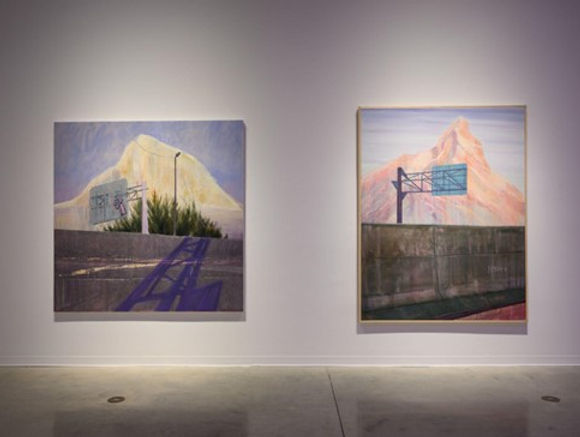
Figure 2. Roadside Banner Series by Andrés Cabrera-García, installation view from Adventum Floridana, The Frank C. Ortis Art Gallery, March 2025. Photo: Dream Focus Photography. Courtesy of the City of Pembroke Pines.
The road itself—liminal, unstable—becomes a metaphor. In South Florida, roads are both veins of development and wounds on the land. Cabrera paints them as thresholds between what once was and what might still emerge. This forward-backward pull echoes the diasporic condition. Born in Remedios, Cuba—a town shaped by coral landscapes and enduring ritual traditions—Cabrera carries with him a bifocal lens. His vision of Florida is not nostalgic, but comparative. Through light, texture, and dislocation, he maps the emotional topography of belonging and alienation.
There is, beneath all of this, a quiet tenderness. Adventum Floridana is not a spectacle of loss, but a meditation on continuity. Despite the rupture, Cabrera’s work affirms that beauty survives in fragments. That memory can be stitched back together. That the land, even in transformation, still holds us—still speaks.
In a time marked by ecological precarity and cultural forgetting, this exhibition reminds us that to witness is to care. To look closely is an act of resistance. And to remember—viscerally, collectively, sensually—is a form of repair.
Notes
-
Maurice Merleau-Ponty, Phenomenology of Perception, trans. Donald A. Landes (London: Routledge, 2012), 146.
-
Robert S. Carr, “Archaeological Evidence for Prehistoric Use of the Atlantic Coastal Ridge,” The Florida Anthropologist 44, no. 3–4 (1991): 307–320.
-
Arjun Appadurai, “The Thing Itself,” in The Social Life of Things: Commodities in Cultural Perspective, ed. Arjun Appadurai (Cambridge: Cambridge University Press, 1986), 5–63.
-
Maurice Merleau-Ponty, “The Intertwining—The Chiasm,” in The Visible and the Invisible, ed. Claude Lefort, trans. Alphonso Lingis (Evanston: Northwestern University Press, 1968), 130.