exhibition.
Curated by Sophie Bonet
The Frank C. Ortis Gallery
Pembroke Pines, FL
Sept 12-Nov 7, 2024


The Crossings: A Global Movement Experience Revealed, The Frank C. Ortis Gallery, 2024.
Photo: Darrell Joseph Photography. Courtesy of the City of Pembroke Pines.
Unbounded Movements:
The Global Tapestry of The Crossings
In an era marked by global upheaval and unprecedented isolation, art has found new ways to transcend borders and foster connection. The Crossings: A Global Movement Experience, conceived by visionary choreographer Damaris Ferrer, is a testament to the transformative potential of collective dynamics. Redefining traditional notions of dance and performance, this project unfolds as a nomadic, participatory choreography—an embodied archive of movement, ritual, and shared humanity.
Rooted in Ferrer’s pedagogical observations as an adjunct instructor at Broward College, The Crossings was born from her students’ difficulty with stillness, presence, and embodied listening. In 2019, Ferrer envisioned a monumental skirt—over 20 feet in length with eight waistbands—not as a costume but as a relational object. The skirt required dancers to move together with intentionality and surrender, tethered by fabric and the necessity of collective rhythm. In its early stages, the piece revealed the theatricality of the object but also exposed the need for deeper kinesthetic empathy among the performers.
Then came the global rupture of 2020. In the enforced stillness of the COVID-19 pandemic, Ferrer reimagined the project’s structure. She replaced the formal choreography with a decentralized “movement score,” inviting participants—now called movers—to engage in unscripted, intentional journeys in open public spaces. No stage. No audience. No spectacle. Only presence. This relational shift echoes Nicolas Bourriaud’s notion that in relational aesthetics, art exists “as a state of encounter” rather than as a finished object.¹
The first official crossing took place in November 2020 at the Long Key Nature Center in Davie, Florida—a poetic and symbolic start over a wooden bridge in a nature preserve.² Ferrer and a small group of movers crossed slowly, silently, wrapped in the skirt, observed not by spectators but by witnesses: community members participating through attention. Since then, the skirt has moved across time zones and cultures—from Bogotá to San Antonio, Singapore to New York—its fabric accumulating signatures, energies, and stories as it travels. Carried in a duffle bag stitched with names, the skirt functions as both a tool and a talisman —a mobile container of memory.


Figure 1, 1b. The Crossings, first official movement score, Long Key Nature Center, Davie, Florida, November 2020. Facilitator: Damaris Ferrer. Movers: Damaris Ferrer, Paola Escobar, Niurca Marquez, Lucila Godoy, Dawn Nunez. Photo: Olivia Kim, Gabriel Kim, Nathalia Novela. Images courtesy of The Crossings.
A pivotal moment came in February 2021 during the San Antonio crossing. On a land bridge known for its ecological and Indigenous significance, the skirt became a site of resistance, healing, and ancestral invocation. The group included cultural workers, artists, and a curandera. Their movements—slow, deliberate, relational—transformed the skirt into a ritual object. Here, Victor Turner’s theory of the “liminal” becomes palpable: a space where normative structures dissolve, giving way to anti-structure, communitas, and spontaneous creativity.³

Figure 2. The Crossings, land bridge ritual movement score, San Antonio, Texas, February 2021. Facilitator: Amber Ortega. Movers: Amber Ortega, Ceiba Ili, Erika Casasola, Rosie Torres, Aimee Villarreal. Photo: Stephanie Hinojosa. Image courtesy of The Crossings.
In July 2021, a crossing in Singapore offered a quieter resonance. Under strict COVID-19 restrictions, a new mother and her friend moved down a city street, children in tow, skirt trailing behind them. The act was tender, domestic, and profound—a gesture of care and continuity across generations. The image is intimate: a stroller, a child, fabric sweeping the concrete—movement as memory, choreography as kinship.
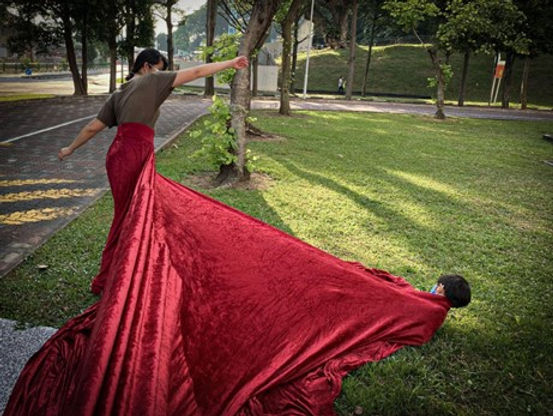
Figure 3. The Crossings, Singapore movement score, July 2021. Facilitator: Bernice Lee. Movers: Bernice Lee and child, Mama and child. Photo: Bernice Lee & Mama O. Image courtesy of The Crossings.
Each crossing is documented through photographs, videos, and testimonies. These materials form a living archive—a multimedia constellation of embodied stories. In Bogotá, the skirt moved through urban sites of political tension. In Upstate New York, it was carried by students across frozen terrain.⁴ With every iteration, The Crossings adapts, resisting permanence and embracing contextual meaning.
_JPG.jpg)
Figure 4. The Crossings, Bogotá movement score, March 2021. Facilitator and mover: Paola Escobar. Photo: Federico Silva. Image courtesy of The Crossings.
Ferrer’s methodology draws from somatic practice and performance studies. The act of wearing the skirt—feeling its weight, responding to its drag—activates Merleau-Ponty’s assertion that the body is not an object in the world but a way of experiencing it.⁵ To move with others is not merely to perform but to sense—to co-create presence.
The exhibition design reflects this ethos. Visitors are not passive observers; they are invited to become witnesses. A central installation features the skirt and duffle bag, surrounded by screens playing crossing footage, audio testimonials, and a “living map” connecting each site. This approach aligns with Jacques Rancière’s call to “emancipate the spectator”—to dissolve the binary between actor and audience.⁶ The result is not a retrospective but a call to attention.
What makes The Crossings remarkable is its refusal of singular authorship. Ferrer sets the conditions, but each crossing is facilitated locally, shaped by the social, cultural, and political textures of its place. The skirt becomes a medium through which community identities and stories are expressed: a form of relational authorship, ritual technology, and global pedagogy.
As global crises challenge the ways we connect, The Crossings offers a model for participatory, embodied engagement—art not as product but as ongoing gesture. Each crossing is an invitation to move differently, to listen, to bear witness. Through its intimate scale and global reach, this project traces a cartography of collective resilience.
Notes
-
Nicolas Bourriaud, Relational Aesthetics (Dijon: Les presses du réel, 2002), 18.
-
Research based on artist interviews and project documentation collected between 2020 and 2024.
-
Victor Turner, The Ritual Process: Structure and Anti-Structure (New York: Aldine Transaction, 1995).
-
Testimonial archives from the digital repository of The Crossings, accessed through Ferrer’s project records, 2023.
-
Maurice Merleau-Ponty, Phenomenology of Perception, trans. Donald A. Landes (London: Routledge, 2012), 147.
-
Jacques Rancière, The Emancipated Spectator (London: Verso Books, 2009), 13–14.
Bibliography
Bachelard, Gaston. The Poetics of Space. Boston: Beacon Press, 1994.
Bourriaud, Nicolas. Relational Aesthetics. Translated by Simon Pleasance and Fronza Woods. Dijon: Les presses du réel, 2002.
Campbell, Joseph. The Hero with a Thousand Faces. Princeton: Princeton University Press, 2004.
Cerny Minton, Sandra. Choreography: A Basic Approach Using Improvisation. Champaign, IL: Human Kinetics, 2007.
Merleau-Ponty, Maurice. Phenomenology of Perception. Translated by Donald A. Landes. London: Routledge, 2012.
Rancière, Jacques. The Emancipated Spectator. London: Verso Books, 2009.
Turner, Victor. The Ritual Process: Structure and Anti-Structure. New York: Aldine Transaction, 1995.